The Quantum Therapist
The Hidden Price of Knowing

“Mr. Levitt, this is an experimental treatment that’s shown promise. However, you should be aware of the risks.” She said. Her voice was clinical and detached, more scientist than therapist.
“While we haven’t had a seizure in human trials there’s a possibility of it. There’s a greater chance of significant personality change and there’s still a risk of damage to your chip.” She studied him, still as the tide before the break.
Eugene Levitt had heard about the new psychotherapy technique through a newsletter. The author wasn’t as well-known as Levitt was, a best-selling author for the past decade. Though the value was immeasurable. It involved connecting the neuralink chip to a quantum computer and showed the patient all the possible paths their life could’ve taken.
Levitt, once on track to make captain in the merchant fleet, had suffered a stroke that left him partially paralyzed. All those years, numbing himself with alcohol and cocaine had finally caught up with him. He volunteered for the first trials of neuralink, hoping for a path that would let him reclaim his mind and body. And now, in the twilight of his life, he volunteered for the next evolution of this technology.
“Going to sea came with risks. This is nothing to me.”
She inhaled deeply. “Mr. Levitt.” She took off her glasses. “You are dealing with infinity—pure mathematical infinity. There’s a risk of you finding singularity.” The words seemed to shake her to her very core.
”The human mind wasn’t made to contain it. I need you to consider that, deeply.”
Her pleading didn’t go unnoticed. Eugene glanced away; his breath quivered. He looked back
”After all I’ve been through—the pain, the loss, the false beginnings—what makes you think I want to come back?” His voice wavered, the dam finally straining under the weight of being.
Dr. Valtham only nodded, clacking away at her tablet.
“If that’s the case, fill this out for me please.” She shoved the tablet toward him. Simple stuff: The patient acknowledges this is an experimental procedure and carries risks. All treatments are done in good faith, and the risks have been fully explained including those to memory, identity and reality itself.
His eyes lingered at the last line, hesitating to sign his mind away.
There’s nothing left for me here. He thought.
He scrawled his name—sloppy, formless, unlike the penmanship he had with real ink—then returned the tablet.
“If you’ll follow me, Mr. Levitt.”
She led Levitt down the corridor, with him hobbling with the assistance of a cane, past the rows of consultation rooms. Her clinic was in a converted warehouse, the scars of its past life still visible. Once a workshop for inflatable boats, the building now held the second iteration of a quantum computer. It hung from the ceiling like an impossibly expensive chandelier. Its components and wiring dangled from its cylindrical body, its boards and interfaces exposed like entrails. Below it sat a dentist chair, the interface secured to the headrest. A simple headband with a sensor and transmitter mounted in the fabric, attached by a thick gauge cable to the monstrosity overhead.
There was a small contingent of medical staff strewn throughout the room. Three technicians and a paramedic. All stopped and looked towards Levitt. He was frightened now.
” Hello Mr. Levitt,” One of the techs said. “Are you allergic to anything?”
” No.”
” Excellent,” she said. She filled a paper cup from the cooler, dropped in a few drops of dark yellow liquid, swirled it, and handed Levitt the solution.
”Alrighty Mr. Levitt. Go ahead and drink all of this for me.”
He looked into the cup and with some hesitation, downed the bitter solution.
The effects were slight at first. First came the spike in his blood pressure. He felt it surge through his abdomen, and his heart throbbed with a warmth he hadn’t felt in years. As the medicine worked, his past surfaced just behind his eyes. He remembered his decision to go to sea—and the love he lost, a wound on his heart that festered until it ruined him.
They met at the cusp of his adult life. Levitt drifted through his prime college years without purpose, working dead-end jobs that paid just enough for his next night out. He found her after storming out of a nursing home job he’d held for less than a year. By chance, they crossed paths at a bar before a concert in the capital. It was the first time Levitt had felt hope. He finally had a future. He imagined their wedding, the life that was waiting for them, the one he could carve out from the sea. And she would be waiting on shore for him, welcoming him home in an embrace fierce with longing. All plotted and mapped out, like the voyage plans he made throughout his career. But the sea lays waste to every plan.
He was guided to the chair, a band cinched around his forehead. The warehouse faded from sight. All he could see was the wound she left behind. She left without warning, told him to forget, to erase the life they had built. It all fell apart when her father suffered a stroke. Levitt was at sea, finishing his final year at the academy. He heard only when they made port in Florida. By that time it was too late. Years of warm embraces, of sweet homecomings.
Gone.
The land offered him nothing, only pain. So he fled to sea, that unforgiving mistress. For many years, he lived his life out of his seabag. It went on like that for months that stretched into years. Endless days at the con in the wheelhouse, leaving no room for healing, or peace. From Guyana he flew home, to a town he no longer recognized. The faces he longed to see were gone. Yet he remained—the same man, only more hollow.
He heard of her now and then, through the grapevine so to speak. He learned that she had run off with a roughneck she met while on vacation to Iceland. She married him and bore his children. After that he quit the sea. He stayed ashore, finding no peace on land. Years later, she died. Leaving behind her two children. Beaten to death by her new husband. He never asked why. Cocaine came soon after. Then the stroke. He never recovered.
“Machine’s coming on, Mr. Levitt. You doing okay?”
He nodded, though his eyes weren’t on the room. They were somewhere lost in time.
The machine woke from above him. A pulse. Steady at first, its pace quickened. Not the hum and whir of old computers. It sounded like a drumline absent its players, hammering the air until all other sounds were drowned out.
The ache bloomed from behind his eyes, radiating from the chip implanted in his brain. The computer pressed deeper, a hot poker digging through bone. The technology was always meant to listen, not speak. It was never meant to force signals in. Yet here he was, breaking ground with his skull.
The images of his past burnt away from his vision, like old film catching fire in an old projector, and restarted. This time, at the beginning. He saw their meeting again, before her father had his stroke. A swell in her belly. His child. In this life, Levitt never finished school. He dropped it all—for her, for the child. They welcomed him into the world. Levitt abandoned the sea. They scraped by, but it was enough. Because some time later, she was pregnant again.
They were together in the delivery room, awaiting their second child. The nurses rushing to her, panic painted across their faces, though he couldn’t see why.
No. This can’t be. Not like this.
He saw the baby delivered. A boy, loud and healthy. He watched his other self clutch her as the light left her eyes. He watched the chaos as the hospital staff tried to bring her back. They failed. He was alone again. Two children, his only memory of her.
He watched them grow. His other self worked to the bone to keep them fed and sheltered. They spent most of their time with their grandparents. When their father was home, he was too tired to play. He watched the years melt together. He saw his eldest spiral into drugs. He saw the suicide, then funeral. He watched his youngest drift further and further away until even that face was gone—until all that remained was his reflection, broken and gray.
This can’t be all I’m destined for.
Then he saw something impossible, and a chill ran through his broken body. He saw himself enter Valtham’s clinic, hooked up to the same machine he now occupied. And he watched, unable to intervene, as not one, but two more realities tore themselves into being.
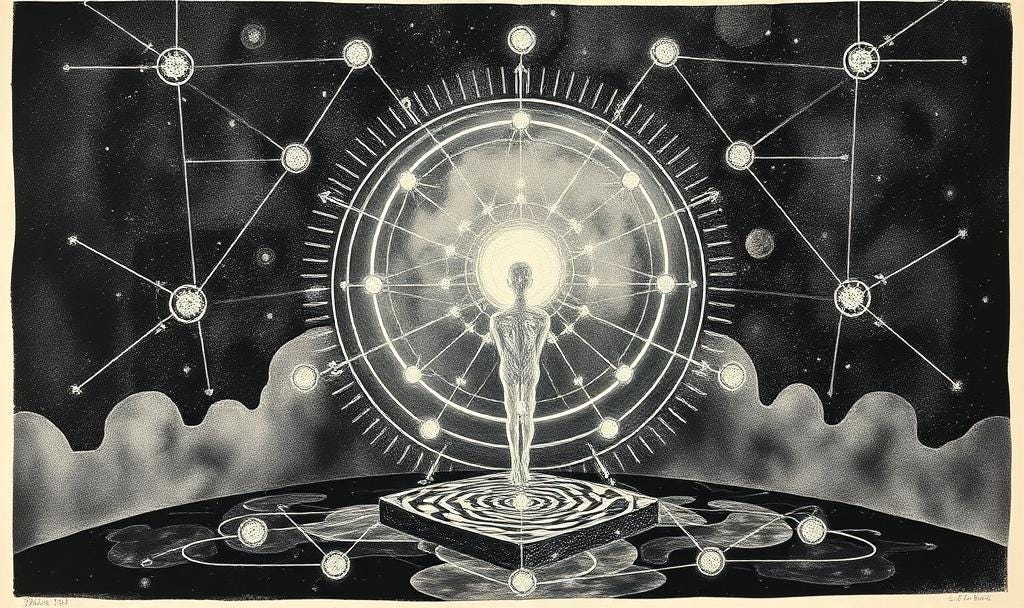
Each unfolded similarly, the cruel patterns repeating with minor variations. But they each included his love’s death—and the clinic—no matter what he did. With every clinic visit, two more realities branched before him. Spiraling out in his vision in a mandala approaching infinity. He saw the pain he carried across countless lifetimes. His heart was pounding, and the chip seared itself into his brain.
All roads led to the machine—and all roads inflicted pain.
The machine began growling, abandoning the rhythmic gallop for something more menacing.
”Mr Levitt, are you doing okay?”
His body was twitching now. He couldn’t hear her past the roar of the machine, showing him infinity. He groaned and moaned in pain. Then began the gurgling.
“Mr. Levitt?” The paramedic rushed to his side.
A golden light appeared in the center of Levitt’s vision. A vivid floater that soon displaced the rest of the infinite mandala taking over his vision. It burnt away the images of his alternate lives. And opened into a singular void.
“He’s seizing! Turn it off!” The paramedic shouted.
The machine fell silent and Levitt’s body convulsed and tensed on the chair. Hands moved to steady him. The smell of ozone filled the warehouses vast expanse as the machine slowly died.
“Don’t be afraid.” A voice called to Levitt from the void. It was angelic, and familiar.
The burning had subsided, and he felt a sense of peace he hadn’t felt since before going to see. He strained to see who called to him from the void.
”Who are you?” He called back.
A womans figure stepped into view from the inky blackness of the void. Her features soft and mournful and hair thick and flowing. Holding a light not even the void before him could swallow.
”Rachael?” Waves of emotion poured through his spirit, her features as angelic and as soft as when he saw them under the full moon on the national mall. He could hear her humming the song she sang to him the first time he left for sea.
”Is it really you?” She stepped forward, at the threshold of the void.
”It’s really me.” He hadn’t heard her voice for many decades, but it was still as rich and as calming as he had remembered it.
”Why did you leave me after all those years?”
”It was a mistake. A selfish mistake.” Her words were soaked in guilt. “I saw the life you wanted, Eugene, and I questioned myself in it. Every path I saw, showed me breaking you.”
“Why are you here now?” He drifted closer to her now. The sensation of his mortal body fading into the void.
”Because I’ve learned we were meant for each other, just not in life.”
Levitt looked behind him and saw the scene that was unfolding. The seizure had stopped but so had his pulse. All he saw were techs and paramedics desperately trying to bring him back to life. Bones snapped under palms as a tech attached the pads of the defibrillator. His gaze returned to his beloved.
”This can’t be real. You can’t be real, you left me. After all this time you torture me and-” His words broke, as he felt her touch again. And remembered her promises unkept.
He could feel the sorrow, and the warmth as she laid her hands on the back of his neck.
”I had to leave you,” her voice wavered with sorrow. “It was the only way we could be together.”
”I-I don’t understand.”
She took his hands in hers, as soft as the shore he’d dreamed of coming home to.
”Don’t you see? Every path, every possible choice you could’ve made. It all led to that machine. To infinity. To us standing here right now in the void. All so I could say I’m sorry for how things played out. But I’m ready to make it right.”
The scene behind him began to fade, swallowed by the images of past lives.
”I wish I could’ve been there for you, when you needed me most.” The dam of emotion finally broke, after many years of neglect. She wrapped him in a warm embrace. Her ethereal body became manifest, as all evidence of the warehouse left his vision.
”Do you remember the gardens? The one we went to before you left for school?” He looked down into her eyes. A distant memory of the roses and lilacs under the moon reflected back at him.
”I’ll never forget it.”
” Remember what I told you the night we got home?”
”That we’d dance together till the end of time.”
She smiled, and took his hands in hers.
” We have a lot of time to make up for. Come with me darling, I’ve waited so long for you.”
He took one final look back and saw nothing of his past life. The apprehension faded as he stepped into the void, his heart made light by the melody she sung.
They danced together, in an endless field of lilac and honeysuckle, under a backdrop of dying stars. After all the years of pain and regret, his soul was finally at ease. He and his love danced in that field.
Until the end of time.
I really enjoyed this. You were able to capture so much conflict and emotion in a short amount of time. I love how creative this piece is. A favorite detail was when you wrote about Levitt's handwriting being sloppy on the tablet compared to his penmanship with an actual pen. Very well written story. Looking forward to seeing more of your work.
This was such a fascinating and haunting read. The mix of science, grief, and infinite possibility gave the story such a heavy weight—I could feel Levitt’s longing and despair with every choice and every imagined life. The writing captures both the ache of regret and the fragile hope of what might have been, and it lingers long after finishing. Beautifully done.